
Double-Hung vs. Casement Windows: 7 Real Differences
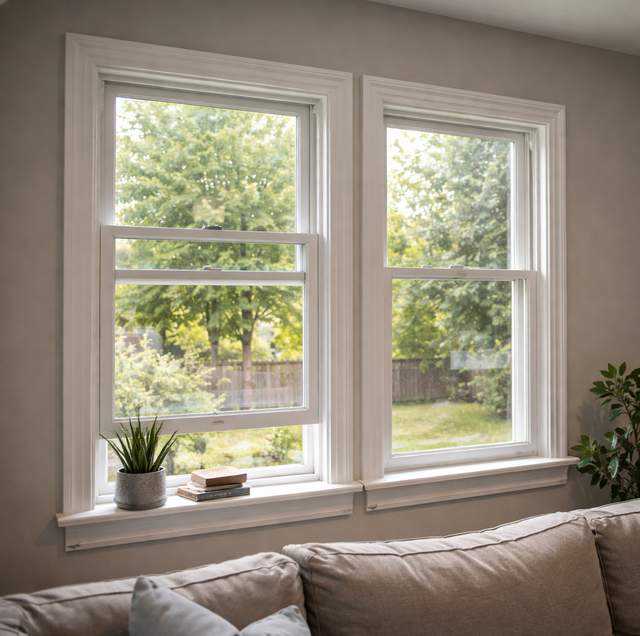
Quick Answer: Double-hung windows have two sashes that slide up and down within a frame. Casement windows are hinged on one side and crank open outward like a door. Casements seal tighter and vent more air; double-hungs are easier to place over obstacles and match traditional homes. Most houses end up using both.
Choosing between double-hung and casement windows sounds like a coin flip until you actually live with the wrong one. A window that fights you every time you open it, or one that never quite seals against a draft, becomes a daily annoyance for the next twenty years. The two styles operate on completely different mechanics, and each one wins in specific rooms and loses in others.
Below you will find how each window works, then the seven factors that decide which belongs in a given opening: ventilation, sealing and energy, cleaning, egress, screens, view, and hardware. By the end, you should be able to walk through your own home and know which style each room wants.
How Each Window Actually Operates
A double-hung window holds two sashes stacked in a single frame. Both the upper and lower sashes slide vertically, riding in tracks along the jamb and held at any height by a balance system hidden inside the frame. You push the bottom sash up or pull the top sash down, and nothing sticks out past the wall. The classic look is the divided-light grid you see on colonial, farmhouse, and most builder-grade homes.
A casement window is a single sash hinged on one vertical edge. You turn a crank at the sill, and the sash swings outward, pivoting like a door on its hinges. Turn it the other way and a set of arms pulls the sash back flush and a lock lever cinches it against the frame. Because the whole sash moves as one panel, a casement gives you an unbroken sheet of glass with no rail cutting across the middle.
That single structural difference, sliding sash versus swinging sash, is the root of nearly every trade-off that follows.
Ventilation: How Much Air Each One Moves
Airflow is where the two styles separate the fastest.
Casement wins on raw volume: Because the sash swings fully out of the opening, a casement clears close to the entire opening for air. The open pane also acts like a scoop: angle it toward a breeze, and it catches passing air and funnels it into the room, which is why casements ventilate strongly even on a still day. If a room feels stuffy and you want the most air a window can give, the casement is built for it.
Double-hung wins on control: A double-hung tops out at roughly half the opening, since one sash always overlaps the other. What it offers instead is placement. Lower the top sash and raise the bottom, and warm air near the ceiling escapes out the top while cooler air enters low.
On a double-hung, lower the top sash and raise the bottom at the same time so warm air near the ceiling escapes up top while cooler air enters down low. That two-way venting freshens a room in any season without a cold draft washing across the floor.
So the honest split is volume versus finesse. Casement for maximum air, double-hung for tuned airflow.
Air-Sealing And Energy Performance
Sealing is the casement's strongest argument, and it comes straight from the hardware.
When a casement locks, the crank arms and lock levers pull the sash tight against a continuous gasket built into the frame, compressing it like a refrigerator door pressing on its seal. That compression closes gaps evenly around all four sides, so a well-adjusted casement is one of the tightest operable windows you can buy.
A double-hung seals differently. Its moving sashes have to slide freely in their tracks, so instead of compressing against a gasket, they rely on weatherstripping in the tracks and a sash lock that draws the two sashes snug where they meet in the middle. That is a good seal, not a compression seal, and the check rail in the center is one more joint that can pass air as the weatherstripping wears.
The energy takeaway holds in any climate. On the coldest nights, a tight casement resists heat loss and drafts a bit better, and on the hottest afternoons that same tight seal keeps conditioned air inside instead of leaking around a sliding sash. Air-sealing is not a winter-only benefit; it earns its keep every month of the year. The gap between a quality double-hung and a quality casement is modest, but if a wall faces steady wind or you are chasing the lowest possible leakage, the casement edges ahead.
Cleaning Both Sides Of The Glass
This one flips depending on which floor you are standing on.
Modern double-hung windows almost always have tilt-in sashes: release two clips or tabs and each sash pivots inward, letting you wash the outside face of the glass from inside the room. On a second or third story, that means cleaning every pane without a ladder, which is a real quality-of-life advantage on a tall house.
A casement handles it differently. Crank it fully open and the outside face of the glass swings into the room's reach, so you can wipe both sides while standing inside. It works, though on some hinge designs the sash sits close to the frame and leaves a narrow gap to reach through. Neither style forces you outdoors, but the double-hung tilt-in is the more foolproof option for upper floors.
Egress: The Bedroom Safety Factor
Every bedroom needs at least one window large enough for a person to climb out in a fire and for a firefighter to climb in. Minimum size, height off the floor, and clear-opening rules vary by locality and by whether the room is a basement, so confirm the current requirement with your contractor or building official before you order anything.
The style matters here because they open so differently. A casement uses its entire opening as clear space when cranked fully back, so a fairly modest casement can satisfy an egress requirement. A double-hung only gives you about half its total opening, so it usually has to be a physically larger window to clear the same rule. In a tight bedroom wall where you cannot fit a huge unit, a casement is often the only way to hit egress without rebuilding the opening.
Screens, View, And Where Each One Fits
Screen placement is reversed: On a casement, the sash swings outward, so the insect screen mounts on the inside of the frame. On a double-hung, the sash slides in inward-facing tracks, so the screen sits on the outside. That has a practical side: a casement's interior screen stays protected from weather and grime but is the surface you look through and touch daily, while a double-hung's exterior screen weathers the elements but keeps your interior view clean.
View favors the casement: With no check rail splitting the middle, a casement gives you one clean sheet of glass, which is why people like them where the view is the whole point. A double-hung's horizontal rail sits right at eye level when you are seated, a minor thing, but noticeable in a room you stare out of often.
Room fit is where it gets practical: Reach is the deciding factor over a kitchen sink or a countertop. Cranking a handle is easy across a deep counter; sliding a heavy sash up and over that same distance is not, so casements are the standard choice above sinks. On tall walls, in stairwells, or in stacked arrangements, double-hungs stack and gang together cleanly and read as traditional, which is why whole facades of older-style homes use them. Casements can crowd a walkway, deck, or patio when they swing out, so they belong where nothing sits in the swing path outside.
Hardware Durability And Matching Your Home
The moving parts wear differently. A double-hung's balance system, the spring or spiral mechanism that holds a sash at any height, can weaken over the years until a sash drifts down on its own; it is a common, and usually repairable, complaint on older units. A casement's crank operator and its steel arms take steady mechanical stress every time you open the window, and the crank gear is the part most likely to strip or grind on a low-end unit. Buying quality hardware matters more on a casement precisely because that mechanism does more work.
Style should anchor the final call. Double-hung is the default vocabulary of colonial, Cape Cod, Craftsman, and most traditional American homes; casements read cleaner and more contemporary, and they were also common on certain historic and cottage-style houses. A window that fights the architecture looks wrong no matter how well it performs, so let the house cast a vote.
So which should you choose? For most homes, the answer is both. Reach for casements over sinks and counters, on walls where you want maximum air or the tightest seal, in bedrooms where egress is tight, and on picture-clean views. Reach for double-hungs on traditional facades, tall or stacked openings, upper floors you want to clean from inside, and any spot where a window cannot swing outward into a walkway. A blend usually beats an all-of-one-style house.
Window replacement is contractor work regardless of style. Sizing an egress opening correctly, flashing the unit so it sheds water, and squaring it in an out-of-true old wall are the difference between a window that performs and one that leaks. If your home was built before 1978, disturbing old painted trim can release lead dust, so that work should follow lead-safe practices.
Frequently Asked Questions
No single unit does both, but a hopper or awning window is the closest hybrid, hinged at the bottom or top and cranking outward like a casement while staying compact. Many homeowners pair a fixed picture window with flanking casements to get a wide view plus strong airflow, which a double-hung array cannot match in a single opening.
A closed casement locked against its gasket resists wind-driven rain well, but a casement left open in a gust is vulnerable because wind can catch the swung-out sash and strain the crank arms. Double-hungs have no exposed open sash to catch wind, so in exposed, gusty locations they are the safer style to leave cracked for ventilation during a storm.
Casements can be safer near young children because the crank can be removed and stored, leaving no obvious way to open the window, and folding-handle cranks sit flush so they are not grabbed. Double-hungs rely on vent latches or sash stops that cap how far the bottom sash rises; those are effective but must be installed correctly on each unit.
Double-hungs pair more easily with mounted blinds and shutters because nothing swings inward to collide with them. A casement's crank handle can hit a lowered blind, so many casement owners choose cordless shades that clear the handle or opt for handles that fold down flat against the sill when the window is shut.
A casement's single uninterrupted sash lets in slightly more daylight than a comparable double-hung, whose check rail and the overlap where the two sashes meet block a thin band of glass across the middle. Over a wall of windows, that difference adds up, which is one reason casements are common in rooms designed around bright, open light.
Casements automate more readily because a small motor can drive the existing crank mechanism, and some are wired to close automatically when a rain sensor trips. Motorized double-hungs exist but are less common and more complex, since the motor must lift the weight of a sliding sash rather than turn a gear, so they carry a higher price and more moving parts.
Book a free in-home window consultation — get the right style matched to every room and a clean, code-correct install. Eagle Home Renovation Inc. serves Richmond and surrounding areas. License #2705181053. Call (804) 538-3334.
