
Is Epoxy Flooring Good for a Garage? The Slab Decides
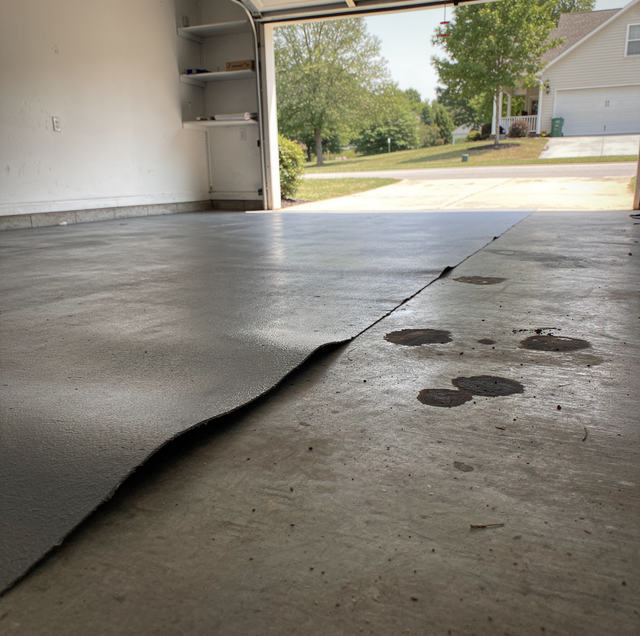
Epoxy is a coating. A coating is only ever as good as what it's stuck to, and on a garage floor that means one thing decides the outcome before anyone opens a bucket of resin: the concrete slab underneath. Most epoxy failures that show up as peeling sheets, bubbled patches, or a floor lifting in the shape of tire tracks aren't failures of the epoxy itself. They are bond failures — the coating separating from a slab never prepared to hold it, or one fighting moisture and oil the whole time it was curing.
That reframes the real question. It isn't about whether epoxy is a good product; it's about whether a specific slab meets the conditions epoxy needs to bond, and what has to happen first. A garage slab faces several conditions that determine whether a coating lasts for years or fails within a season.
| Slab Condition | What It Means | What It Needs First |
|---|---|---|
| High moisture vapor emission | Water is pushing up through the slab from below, with nowhere to go once it's sealed under a film | A vapor probe or calcium chloride test, and possibly a moisture-mitigating primer |
| Smooth, troweled surface | No mechanical profile for a coating to key into | Diamond grinding or shot blasting to open the surface |
| Glossy patches or an old sealer | A prior coating or densifier is already occupying the surface | Removal of the existing layer, not a coat applied over it |
| Oil-soaked concrete near the parking spot | Petroleum has worked into the pore structure | Degreasing and profiling before any primer touches it |
| A hairline, static crack | The concrete has already settled and stopped moving | A rigid filler that locks the crack together |
| An active or seasonal joint | The slab is still expanding and contracting | A flexible filler that moves with it, not a rigid one |
Moisture Vapor Coming Up Through the Slab
A garage slab poured without a vapor retarder beneath it (a layer of polyethylene sheeting under the concrete) stays in direct contact with the soil, and damp soil pushes moisture upward through the pore structure by capillary action and vapor pressure. Warm ground raises that pressure and pushes moisture up faster; cold, saturated ground still feeds it from below, just more slowly. Neither condition dries the slab on its own.
Once a coating cures, it's close to impermeable. Vapor that used to evaporate off a bare slab now collects at the bond line, and that trapped moisture shows up later as bubbling, a white haze under the coating, or sheets lifting free. A calcium chloride test (a sealed dome taped to the slab, collecting moisture emission over a set period) or an in-situ relative humidity probe is how a professional decides whether a slab is dry enough to coat directly or needs a vapor-mitigating primer first. What counts as passing comes from the product's own datasheet, not from a rule of thumb.
Surface Profile: Why Grinding Beats Acid Etching
Epoxy doesn't just chemically bond to concrete; it needs a mechanical profile to key into, a roughened, porous surface for the resin to physically grip as it cures. Diamond grinding and shot blasting create that profile by abrading the top layer of concrete, opening the pore structure and exposing fresh aggregate evenly across the slab.
Acid etching (the older method, using a diluted muriatic acid wash) opens the surface chemically by dissolving some of the cement paste at the top, but results are inconsistent: they depend on how thoroughly the acid is mixed, how dense the concrete is, and whether the reaction and its salts get fully rinsed afterward. It also doesn't remove an existing sealer or heavy staining, just etches around it. Grinding and blasting physically remove that top layer, oil and sealer included, for a consistent profile a coating can grip.
Diamond grinding and shot blasting throw airborne silica dust that requires engineered dust control to handle safely, and acid etching involves acid handling and fume exposure. Both are professional work, not a weekend project.
Old Sealers, Old Coatings, and Years of Oil Contamination
A garage floor in use for years usually has more sitting on it than plain concrete: a prior cure-and-seal spray, a roll-on "epoxy paint," or a clear densifier, all of which occupy the surface and block grinding equipment from reaching fresh concrete unless removed first.
Oil, transmission fluid, and tire-dressing residue accumulate under the parking footprint, and petroleum works its way into the pore structure with repeated exposure. Degreasing with an alkaline cleaner, sometimes more than once, pulls that oil out before grinding starts. Skip it, and grinding an oil-contaminated slab can drive oil deeper into the freshly opened pores, leaving a contaminant at the bond line no primer will stick to.
Cracks and Joints Need Different Treatment
Not every crack is the same problem, and treating them alike is a common reason a coating fails at the same line where the concrete already failed. A static crack has already happened: the slab settled, opened, and stopped moving. A joint or active crack is still moving with the seasons, expanding and contracting with the slab and the ground beneath it.
Saw-cut control joints are intentionally placed at the pour, creating a planned weak point so the concrete cracks in a straight, predictable line rather than randomly. A coating carried straight across one without addressing it first sits on a seam still working underneath, and the movement telegraphs through as a matching crack in the coating. A static crack gets a rigid epoxy filler that locks the two sides together; an active joint gets a flexible polyurethane filler that moves with the slab instead of fracturing again.
The Coating System Is Layers, Not One Product
A garage epoxy floor is a system built in stages, not a single can applied once. The primer coat penetrates the profiled, cleaned concrete and wets out the pore structure, grinding it open, giving the next layer something to lock onto. The build coat, the main pigmented layer, is usually a 100% solids epoxy rather than water-based: no solvent evaporates as it cures, so a thicker single-pass film provides greater wear resistance than a water-based system. A vinyl flake or quartz broadcast is applied to that build coat while it's still wet, adding color and texture. The topcoat is frequently polyaspartic or polyurethane/polyurea rather than a second coat of epoxy, since those chemistries cure faster and better withstand UV and abrasion.
Both undercure and overcure are possible outside a product's recommended temperature and humidity window, so ask the installer what conditions each layer needs and how they're planning the job around the forecast before it's scheduled.
Hot-Tire Pickup and UV Yellowing: the Two Failure Modes Homeowners Actually Meet
Hot-tire pickup happens because a car's tires heat up from highway driving and radiate that heat into the coating once parked. The film softens slightly under that heat, and when the car pulls away, it can lift a thin layer of coating or leave a visible tread pattern. This is a combination of bond strength and thermal cycling, not a verdict on epoxy as a material: a fully cured film with a proper profile and a heat-tolerant topcoat resists it far better than a film with a weak bond or an early cure.
UV yellowing is a separate failure mode with a chemical cause. Sunlight breaks down a coating's resin at the molecular level, and how much depends on its chemistry. Standard epoxy resins are aromatic, built around a ring structure that absorbs UV energy and breaks down over time, resulting in yellowing or dulling of color. Aliphatic resins, used in polyaspartic and polyurethane topcoats, lack that ring structure and hold color far longer under the sun, which is why many systems apply an aliphatic topcoat over an aromatic epoxy build coat rather than leaving epoxy exposed as the final layer.
Slip Resistance in a Garage That Sees Wet Tires and Drips
A garage floor gets wet the way few coated floors indoors do: tires track rain or snowmelt across the slab, and a parked car keeps dripping onto the same spot the whole time it sits there. A smooth, glossy epoxy film becomes noticeably slipperier than bare concrete under that film of water because the coating fills in the fine texture that gave bare concrete its grip. An aggregate additive, fine polymer grit blended into the final coat or the same quartz or flake broadcast used for texture, restores that texture without changing how the coating bonds to the slab. It's a specification decision made before the job starts and confirmed with a measured coefficient-of-friction test on the cured, wet surface, since the aggregate goes into the final coat and can't be added once someone notices the floor is slick.
When Epoxy Is the Wrong Answer for a Garage
Epoxy isn't the right specification for every slab. A slab with persistent, high moisture vapor emission that mitigation cannot bring inside the product's tolerance will keep fighting any coating over it: trapping water is trapping water no matter what sits on top. A floor with extensive existing damage, where an even profile isn't realistic, is also a weak candidate. A garage used heavily as a workshop, with frequent chemical exposure or dropped tools, may be better served by an entirely different system.
Chemical spills and a dropped tool: garages see fuel, brake fluid, battery acid, and solvents an interior floor never does. A standard epoxy film resists brief contact with most of these, but sustained exposure can soften or discolor it in a way a polyaspartic or polyurea topcoat handles better. Impact is related: cured epoxy is a fairly rigid, glass-like polymer that a dropped socket set or jack stand can chip or crack rather than dent, whereas polyaspartic and polyurethane topcoats stay flexible enough to absorb the impact instead.
When a slab or a garage's use rules out epoxy, there are real alternatives. A polyaspartic or polyurea system can be specified for the entire floor, providing the same fast cure and UV stability throughout the film. A penetrating sealer or densifier offers a lower-build option that still reduces dusting and staining without the aggressive profile that a full system requires. Modular interlocking floor tile sits on top of the slab as a floating floor rather than bonding to it, sidestepping the moisture and bond question entirely and trading a continuous surface for a tiled, not monolithic, one.
Frequently Asked Questions
A freshly poured slab continues to lose internal moisture from the hydration process well after it's hard enough to walk or park on, and coating it too early can create the same vapor problem that a test would catch on an older slab. Installers want a slab well past its initial pour before scheduling the job, separate from what a later moisture test shows.
Yes, but the film has to be cut and terminated cleanly at the drain's flange or trench edge rather than run over the opening. Otherwise, water draining through it can wick sideways under the coating's edge and undermine the bond around the drain.
A radiant-heated slab puts the coating through a heating and cooling cycle every time the system runs, on top of whatever swings the garage sees anyway. The product specified over it needs to be rated for that thermal cycling, not a standard system chosen without accounting for the heat underneath.
The aggregate is sealed under the topcoat, so ordinary traffic doesn't strip it out the way a topical additive wears off bare concrete. A tool chest or cart dragged over the same path for years can eventually polish that stretch smooth enough to need re-broadcasting.
Yes. A spalled or pitted patch, surface deterioration distinct from a crack, can be repaired without redoing the floor, but the patch has to be brought level and profiled to the same standard as the surrounding slab before the field coat goes down. That's why it's handled as part of professional slab preparation rather than as a separate touch-up job.
A concentrated, static point load left in one spot can create a small localized indentation over time, a different mechanism than the impact chipping of a dropped tool or the heat-driven pull of hot-tire pickup. A load-spreading pad under a kickstand or jack stand is sometimes recommended for that reason.
Get a garage slab evaluated before a coating gets specified for it — professional testing and preparation are what prevent the failures that show up months later. Eagle Home Renovation Inc. serves Richmond and surrounding areas. License #2705181053. Call (804) 538-3334.
