
Why Freeze-Thaw Damages a Concrete Patio From the Inside
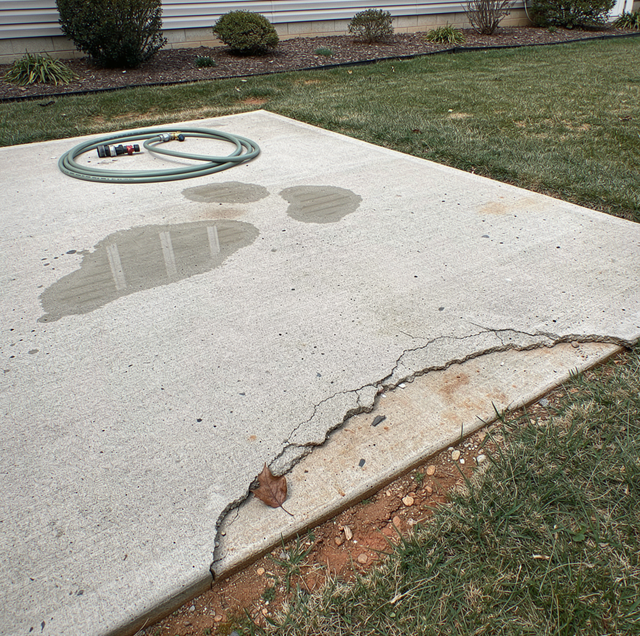
Concrete is not solid. Hardened cement paste is a network of capillary pores, most a few thousandths of an inch across or smaller, and after rain a large share of them hold water. That is normal. The trouble begins at the phase change.
When the water in one of those pores reaches its freezing point, it turns to ice and occupies roughly 9 percent more space. Ice will not compress, and the pore walls will not stretch, so something has to move: the water that has not yet frozen. As the ice front advances, it drives that liquid ahead of it, out through channels narrowing to millionths of an inch, and the resistance builds hydraulic pressure inside the paste. Cement paste is strong in compression and weak in tension, so when the pressure passes its tensile limit, the paste splits. That first crack is microscopic, and it is the start of every symptom below.
Quick Answer: Freeze-thaw damage begins when water in the slab's pores freezes, expands by about 9 percent, and forces unfrozen water through the paste under pressure. Repeated cycles crack the paste from within, then surface as scaling, spalling, joint breakdown, and heave.
Two further pieces decide how much harm a night does. Pore water does not all freeze at 32 degrees: the finer the pore, the lower the temperature at which its water turns to ice, so the slab undergoes a staggered freeze. The second piece is saturation. Below roughly 85 to 90 percent saturation of the capillary system, the 9 percent expansion has empty space to move into and nothing breaks. Above that, there is nowhere for the water to go. How wet the concrete is, not how cold the night gets, decides whether a freeze costs you anything.
Repetition Is What Turns Microcracks Into Visible Damage
One freeze does almost nothing to sound concrete. The damage is cumulative and feeds itself: each cycle lengthens the microcracks left by the last, which raises the paste's permeability, letting the slab take on water faster and hold more, which brings the next cycle closer to the saturation threshold.
So the count of crossings matters more than the coldest reading, and a slab runs more of them than the calendar suggests. Concrete responds to sun and shade, not to air temperature. A patio in afternoon sun can thaw at the surface on a day the air never rises above freezing, then refreeze after dark. A standard durability test puts specimens through 300 rapid cycles for that reason.
The consequence cuts two ways. A mild winter that crosses 32 degrees dozens of times can be harder on a patio than a severe one that freezes the slab in December and holds it there, because concrete kept continuously below freezing is not cycling and is not being pumped.
Surface Scaling Is the Cycle Working on the Top Few Millimeters
Scaling is the flaking away of mortar from the finished face. It starts shallow, around a sixteenth of an inch, in patches that read as ordinary weathering, then deepens past three sixteenths and the coarse aggregate shows through, rough and loose underfoot.
The top layer goes first for three stacked reasons. It saturates first, because rain lands on it and puddles sit on it. It freezes first, because it is the face losing heat. And it is often the weakest concrete in the slab, because of finishing. Fresh concrete bleeds water upward after placement, and troweling before the bleeding stops works that water back into the top layer under a dense skin, which later separates as a sheet. Hard steel troweling adds a second problem outdoors: it crushes and drives out the tiny air voids that give freezing water an escape route, in exactly the layer that needs them. Exterior flatwork wants a float finish and a broom texture applied after bleed water has left.
De-icing chemicals do most of their work in this same layer, and the mechanism is not the obvious one. Sodium chloride does not dissolve concrete. It lowers the freezing point of the water film on the surface, so a treated slab holds liquid water at temperatures where an untreated one would remain frozen, and the brine melts and refreezes as it dilutes. One cold night becomes several crossings, and every crossing loads the same paste again. Chlorides also hold moisture that would otherwise have evaporated, keeping the surface near the saturation threshold.
A few de-icers go further and attack the paste chemically. Ammonium-based products, including fertilizers used as improvised ice melt, react aggressively with cement paste and should never come into contact with a slab. Magnesium chloride reacts with the calcium hydroxide in hardened paste and can break down the calcium silicate hydrate that binds the concrete, leaving a soft, chalky surface. Calcium chloride can form calcium oxychloride, an expansive compound that develops in concentrated solution at low temperatures and damages the paste even without freezing.
Edges and Corners Spall First Because They Chill From More Than One Face
Walk a failing patio and the perimeter is almost always worse than the middle. Geometry explains most of it. Concrete in the field of the slab loses heat through one face; an edge loses it through the top and the vertical side; a corner loses it through the top and two sides. That corner reaches freezing sooner, gets colder, and stays frozen longer than concrete four feet inboard, so it runs more cycles, including deeper ones.
Restraint explains the rest. Concrete in the middle of a slab is surrounded by more concrete pushing back against tensile splitting, while an edge has free faces and nothing to lean on. Add that water drains toward the perimeter, that settled soil often holds a damp band against the outside face, and that the edge is the wettest and least supported part of the slab. The failure looks different from scaling: pieces break away in chunks carrying coarse aggregate, leaving a ragged lip with sound concrete behind.
A spalled slab edge is a trip hazard and may also be unsupported. Concrete that has lost its bearing can snap under a single step. Keep foot traffic and furniture off any perimeter that has broken away or moves underfoot.
Control Joints and Cracks Hand the Cycle a Route Inward
Control joints are cut or tooled to roughly a quarter of the slab thickness, so the shrinkage crack every slab makes happens where you put it. They work, and they open a route into the body of the concrete.
A joint holds water, so the concrete on both faces runs at higher saturation than the rest of the slab, cycles more often, and breaks down along the shoulders. A second failure gets blamed on frost and is not frost at all. Joints are widest in cold weather, when the slab has contracted, and that is when grit falls in. Come summer, the concrete expands and tries to close the joint against material that will not compress, and the stress releases by spalling the shoulders. A flexible sealant over a backer rod, with the sealant roughly half as deep as the joint width, keeps water and grit out while allowing the joint to move.
Do not fill a control joint with rigid mortar or unbacked sealant. A joint filled solid cannot move, and the slab relieves the stress by cracking somewhere you did not choose. Use a backer rod under a flexible sealant.
The Subgrade Freezes Too and Lifts the Slab Off Its Support
The same physics operates in the soil under the patio and behaves differently there. Frost-susceptible soils are the fine-grained ones: silts and silty clays hold water by capillary action yet remain permeable enough to keep it moving. As the freezing front works down, water is drawn up to it and freezes as lenses that grow along the plane, lifting everything above them.
A heave of an inch or more is common and uneven because moisture and soil texture vary within a few feet. Concrete is weak in tension, so a slab lifted at one point and held at another cracks across the difference. Then the ground thaws, the lenses melt, the soil consolidates, and the slab settles into a shape that is not the one it left, with voids underneath and load now carried in bending across an unsupported span.
The defense is drainage and base material rather than the concrete. Four to six inches of compacted open-graded crushed stone under the slab interrupts capillary rise and drains the underside, so the freezing front has nothing to feed on, and grading that carries surface water away does the same job above ground. Clay soils that swell and shrink with moisture add their own seasonal movement from below.
Air Entrainment and Sealing Change the Pressure, Not the Weather
What entrained air actually does
Air-entrained concrete carries a deliberate system of microscopic bubbles, most between roughly 0.0004 and 0.04 inch across, created by an admixture at the batch plant and distributed through the paste at about 5 to 8 percent of the concrete volume for exterior flatwork. They are not the large irregular voids left by poor consolidation. They are pressure relief: when an ice front pushes unfrozen water through the paste, an empty void within reach gives that water somewhere to arrive, and pressure never reaches the cracking threshold.
Within reach is a measured distance. The spacing factor, the average distance from any point in the paste to the nearest void, needs to be about 0.008 inch or less, and the voids stay empty in service because they are too large for capillary suction to fill. Mix water matters alongside them: a lower water-to-cement ratio produces a finer, less connected capillary network and less freezable water, which is why exterior flatwork is normally specified at 0.45 or below. Concrete placed without entrained air will scale outdoors, and nothing applied later can restore the void system.
What a sealer changes and what it does not
Penetrating silane and siloxane sealers soak into the top layer and line the pore walls with a water-repellent film. They do not plug the pores, so vapor still leaves the slab, but capillary absorption drops sharply. What they change is the saturation level, the variable that decides whether a freeze does damage at all. That effect is real and limited: a sealer adds no strength, restores nothing already flaked away, and cannot substitute for air entrainment.
Film-forming acrylics behave differently. They sit on the surface and give a wet-looking gloss, and on a slab taking up moisture from below, that film can trap it and feed the delamination it was bought to prevent. Solvent-borne products carry a separate hazard: the vapor is heavy, flammable, and pools in low, enclosed spaces, so a screened porch or walled courtyard needs cross-ventilation and no ignition sources nearby.
None of this stops the weather. Air entrainment, a low water-to-cement ratio, a sound base, sealed joints, and drainage all work on two variables: how saturated the concrete gets, and whether the pressure inside has anywhere to go.
Frequently Asked Questions
Yes, and it is a separate failure from ordinary freeze-thaw. Plastic concrete is mostly water, and if it freezes before reaching roughly 500 psi compressive strength, ice disrupts the paste while it is still forming and the lost strength never returns. Cold-weather placements use blankets, heated enclosures, or accelerating admixtures for that reason.
Air content is verified load by load, not slab by slab. A ready-mix truck's air is measured with a pressure meter, and readings can differ by two or three percentage points between loads during a single pour. A panel placed under a low air load then fails alone, beside panels that hold up fine.
There is a trade-off. Snow cover insulates the slab and stabilizes its temperature, reducing the number of cycles it runs, while clearing to bare concrete exposes the surface to full daily temperature swings. Clearing is still right where people walk, but scraping a rarely used patio to the finish gains nothing and chews up a surface that may already be scaling.
Traction and melting are different jobs. Coarse sand or crushed traction grit provides immediate footing and adds no chloride, though it needs sweeping up in spring. Calcium magnesium acetate is a chloride-free de-icer that is far gentler on cement paste, but it works slowly and fades below about 20 degrees, so it has to go down before ice forms.
Contractors map it by sounding rather than by eye. Dragging a length of chain across the slab or tapping with a hammer gives a dull, hollow note over delaminated concrete and a sharp ring over sound concrete, which outlines failed areas that still look intact. A bonded resurfacer needs sound concrete to grip, so widespread delamination points to replacement.
Test it rather than following a calendar. Sprinkle water on the slab: if it beads, the sealer is working, and if it soaks in and darkens the concrete within about a minute, the treatment has worn through. Traffic paths wear first and can be spot-treated. Most penetrating sealers need a clean, dry slab above roughly 50 degrees with no rain expected for 24 hours.
Book a patio assessment before another winter runs the cycle — a slab caught at the scaling stage is a repair, while one left until the edges break away and the base voids out becomes a replacement. Eagle Home Renovation Inc. serves Richmond and surrounding areas. License #2705181053. Call (804) 538-3334.
