
How Do You Prep a Concrete Floor Before Epoxy? 5 Tests
The coating lets go along one edge first. A scraper slides under it near the garage door, and a piece a foot across peels up in a single continuous sheet. Flip it over: the back is glossy, dry and clean, and the slab it came off is still smooth and grey. Nothing in the film broke.
The part of prep you can check is measurement. Five readings tell you whether your slab can hold a coating: how fast a water drop disappears, how much vapor the concrete passes, how the ground surface reads against a numbered chip, whether a crack moves between two dates, and how much powder a strip of tape lifts. Take all five before you open a pail. Epoxy does not fail in the film. It fails at the line where the film meets the concrete.
What a Drop of Water Tells You About the Surface
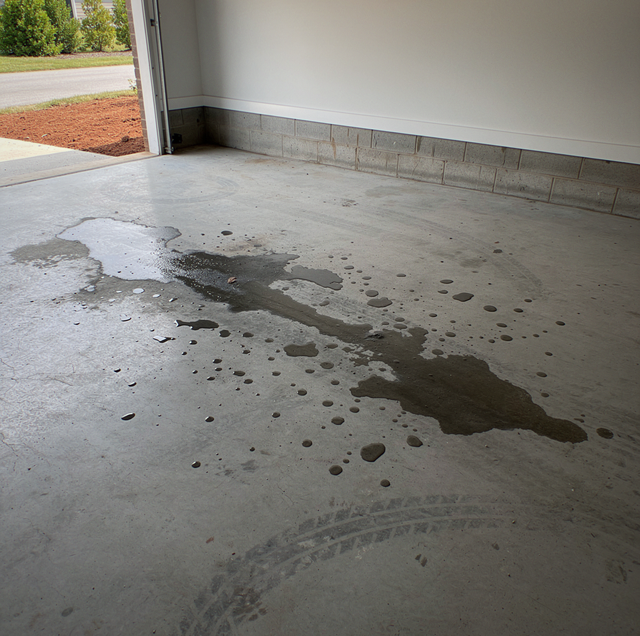
Start with water. Flick a few drops onto the floor in six or eight places: near the door, in the middle, under where a vehicle parks, in a corner. Bare concrete darkens as it takes in water, and on an open slab, that happens within a minute. A drop still beading after five minutes says something is in the way.
What beads is a film: a curing compound sprayed onto fresh concrete, an acrylic sealer rolled on later, or an old coating you inherited. All three close the pore structure at the top of the slab, and open pores are the only thing an epoxy has to hold on to. Motor oil beads from below, having worked down into the pores.
The reading names the location rather than the contaminant, which is enough to work with: mark every spot that beaded and cut those first. Whether a coated floor is the right finish for your garage is a separate question; this one is about reading the slab underneath it.
Three Moisture Tests and the Numbers They Return
Water moves upward out of the soil and through your slab as vapor. A cured epoxy film is close to vapor-impermeable, so that vapor condenses at the bond line, carrying dissolved alkalis that raise the pH against the back of the film until adhesion breaks. The floor looks perfect through the first season, then lifts in whole sheets.
Three methods measure it, and each answers a different question.
| Test | Reads | Duration | Output |
|---|---|---|---|
| Plastic-sheet moisture test | Condensation under a taped 18-inch polyethylene square | 16 hours | A yes or no, by eye |
| Calcium chloride test | Vapor into a weighed dish of dry calcium chloride under a dome | 60 to 72 hours | Pounds per 1,000 square feet per 24 hours |
| In-situ relative humidity test | Humidity inside the slab, via a sleeved probe in a drilled hole | 48 hours conditioning, then 24 per probe | A percent, at depth |
Depth is why they are not interchangeable. The plastic-sheet and calcium chloride tests read the top of the slab, so a floor drying in a warm room can pass either while the concrete an inch down is still saturated. The in-situ probe test reads where the water is. A handheld meter sits between the two, reading by electrical impedance to roughly an inch. Use it to map the slab and find the wet corner before you commit to a 72-hour test, and treat its number as comparative: your product's tolerance is written against the calcium chloride or in-situ probe result.
An in-situ probe reads conditions inside the slab rather than at its face. Drill the sleeve to 40 percent of a ground-supported slab's thickness. Condition the space for 48 hours first, then let each probe sit 24 hours before you read it.
Two figures anchor the result: 3 pounds per 1,000 square feet in 24 hours on the calcium chloride test, and 75 percent relative humidity on the in-situ probe test. Where your data sheet and the anchor figure disagree, the sheet governs. Above that limit, the slab first receives a moisture-mitigating epoxy membrane, or it stays bare.
Reading the Ground Surface Against a Profile Chip
Epoxy adhesion is mechanical: the resin flows into surface irregularities, cures, and is held by the shape it formed. A power-trowelled slab offers none. Finishing brings a film of fine cement and water to the surface, called laitance, and a coating bonded to that film adheres to the weakest eighth of an inch of your floor.
Roughness has a physical reference. A standard set of concrete surface profile chips is numbered CSP 1 through CSP 10, molded replicas you match against the ground floor by sight and touch. Surface-preparation guidance maps thin films under roughly 10 mils to CSP 1 through 3, and heavier builds to coarser profiles. A garage system runs 10 to 20 mils, above that thin-film band, so the reading to grind toward is CSP 3 or coarser.
Diamond grinding lands between CSP 1 and CSP 3 depending on how coarse its segments are, so your tooling choice decides whether you reach the number. Shot blasting drives steel shot from a centrifugal wheel and gets to CSP 3 and beyond, with shot size and travel speed setting the depth.
Dry grinding concrete releases respirable crystalline silica, particles fine enough to reach deep lung tissue and scar it permanently. A shrouded head with a tool-mounted HEPA extractor, or grinding wet, plus a fitted respirator are the controls that cut the exposure.
Acid etching returns roughly CSP 1 and stops there; under the profile, a 10 to 20 mil build wants. It reacts only with exposed cement paste, so a sealer, an old coating, or an oil-soaked patch stays put, and the result varies with dilution, concrete density, and rinsing. Disposal of the rinse water, and any obligation attached to dust control on your property, go to your local building authority.
Measuring Whether a Crack Is Still Moving
A cured film has no structural span, so whatever the concrete does under it, the coating does with it. One question is worth measuring before you fill anything: is this crack still moving?
A caliper and a month will answer it. Mark two points on opposite sides of the crack, far enough back that both sit on sound concrete, measure the span, and pencil the number and the date onto the slab. Measure again four weeks later. A shrinkage crack in a slab that finished drying years ago returns the same number twice. A crack still working returns a different one, and the difference can sit in the thousandths, below what your eye would catch.
Two matching readings make the crack dormant, and a dormant crack takes a rigid fill: a chased square kerf, vacuumed, filled with low-viscosity epoxy or polyurea and ground flush.
Two readings that differ, and every saw-cut control joint, change the answer. Fill either rigidly, and the slab cracks the filler and the coating above it along the same line within a season or two. Honor the joint instead: saw-cut the coating back open over it and fill with a flexible sealant, or accept a visible line.
The Tape Test After the Grinder
Grinding solves the profile problem and creates a contamination problem in the same pass. The cut produces micro-fine concrete powder that packs down into the exact profile you just opened. Epoxy rolled over it bonds to loose dust; the dust is held to the slab by nothing, and your whole floor is waiting to release. This is the last reading, and the one nobody takes.
Run the machine with its vacuum attached while you cut, then vacuum the bare floor in two full passes at right angles to each other, because a single direction leaves powder sitting in the lee of the profile. Vacuum the walls up a foot and every ledge and sill, since dust that falls during coating lands in wet resin.
Then check it with a method that registers dust too fine to see. A ground floor reads clean from standing height, while it still holds powder you can feel with a fingertip. Press clear packaging tape firmly onto the surface in three or four places, one of them near a wall where you ground by hand, lift each strip and hold it against something white. Grey haze on the adhesive means the floor is not ready. Vacuum again and pull a fresh strip.
Resist the urge to mop: water goes into the open pores you just cut and has to come back out through whatever you put on top. A freshly ground floor starts collecting airborne dust the moment the vacuum stops, so your tape reading has a shelf life. Coat the same day you finish grinding, and the reading still describes the floor you are coating.
Frequently Asked Questions
Not until the oil is out of the pore structure, and grinding first will not do it: the wheel carries contamination down into the pores it opens. Wash with an alkaline degreaser, then draw the rest out with a poultice, an absorbent powder mixed with solvent to a paste and left under plastic over the stain for 12 to 24 hours. Epoxy over residual oil pulls back as it cures, leaving round craters called fisheyes.
The 28-day figure comes from strength testing. A standard compression test breaks cylinders at 28 days, the age at which a mix is taken to have reached its specified compressive strength. It is a structural number and says nothing about how much water is still leaving your slab, so age and dryness get checked separately.
Dry, and warm enough that it is not pulling water out of the air. Concrete holds its temperature far longer than a room does, so your slab can sit below the dew point while the air feels fine and condensation forms on it. Standard painting guidance sets the margin at 5 degrees Fahrenheit of surface temperature above the dew point; your coating's data sheet states its own.
A walk-behind grinder covers that area comfortably and cuts high spots down as it goes. A shot blaster runs its steel shot in a closed loop, recovering it with a magnetic separator while an integral vacuum pulls the fines, making it fast and nearly dustless on the open floor. Neither reaches the last few inches at a wall, so your perimeter gets ground by hand.
That is efflorescence: dissolved salts carried up by water moving through the slab and left behind when the water evaporates. It is soft; it is not bonded to the concrete, and a coating over it bonds to the powder. Take it off mechanically with the grinder instead of washing, which dissolves the salts back into the slab.
Three for the first 1,000 square feet, plus one for every additional 1,000: both the calcium chloride and in-situ probe tests set that sampling density, and both direct you to place readings where the slab is wettest, near exterior walls, at columns, and anywhere the floor has stained or stayed dark. One probe in a two-car garage is a sample of one.
A slab assessment before any product gets chosen — the moisture reading, the profile plan, and the bond check for your garage or basement floor- so the prep is scoped before the coating is. Eagle Home Renovation Inc. serves Richmond and surrounding areas. License #2705181053. Call (804) 538-3334.
