
Quartz vs Granite Countertops: Which Wins for Your Kitchen?
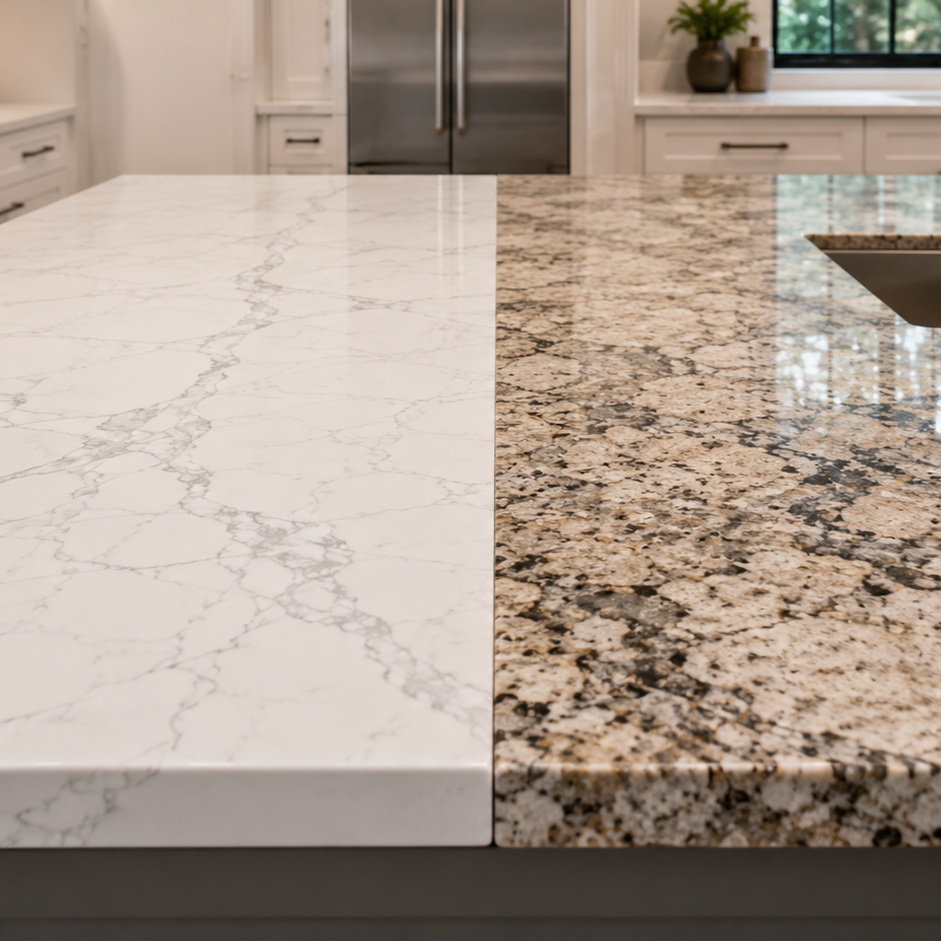
Quick Answer: Both last for decades, but they're tough in different ways. Quartz is engineered stone — non-porous, so it resists stains and bacteria and never needs sealing, but its resin binder can scorch above about 150°F and can fade in direct sun. Granite is natural stone — more heat-resistant and UV-stable, with one-of-a-kind looks, but it's porous and may need occasional sealing. Quartz wins on low maintenance; granite wins on heat and sunlight.
You're standing in the showroom between two slabs that cost about the same, and both promise to outlive your kitchen, and the salesperson has an opinion about each. Quartz and granite are the two heavyweights of countertops for good reason — both are very durable — but they fail and shine in opposite places. Knowing which differences actually matter day to day is how you pick the one you won't second-guess.
What They Actually Are
Granite is 100% natural stone, quarried in slabs and cut to fit. Because it formed underground over a very long time, every slab is unique — the veining and flecks in yours exist nowhere else — and because it's natural stone, it's porous, with microscopic openings that can absorb liquid.
Quartz countertops are engineered. They're made from roughly 90 to 95% ground natural quartz blended with resins, polymers, and pigments, then formed into slabs. That manufacturing gives quartz two defining traits: it's non-porous, so nothing soaks in, and its color and pattern are consistent and controllable, which is why quartz comes in a huge range of uniform looks. The resin that makes quartz non-porous is also the source of its two weaknesses, as you'll see.
The Head-to-Head
Here's how they compare on the things that actually decide a kitchen.
| Factor | Quartz | Granite |
|---|---|---|
| Porosity / sealing | Non-porous; never needs sealing | Porous; may benefit from periodic sealing |
| Stain resistance | Excellent (nothing soaks in) | Good if sealed; can stain if neglected |
| Heat | Resin scorches above ~150°F; use trivets | More heat-resistant; still use trivets |
| Sunlight / UV | Can fade or yellow in direct sun | UV-stable; holds color outdoors |
| Look | Uniform, consistent, many colors | Unique natural variation, one-of-a-kind |
| Hardness | Very hard (~7 Mohs) | Very hard (~6–7 Mohs) |
Where Quartz Pulls Ahead
The big one is maintenance. Because quartz is non-porous, it doesn't absorb wine, oil, or coffee, and it never needs sealing — wipe it, and you're done. That same non-porous surface resists bacteria and mildew that can settle in unsealed natural stone, which is part of why quartz is popular for busy family kitchens. Both materials are hard enough to resist everyday scratches — quartz rates around 7 on the Mohs scale, granite about 6 to 7 — but you should still cut on a board on either, since a knife can mar both and dull your blades.
For consistency, quartz also wins: if you want a specific color or a uniform look across a big island, engineered quartz delivers it slab to slab, where natural granite varies.
Where Granite Pulls Ahead
Granite's advantages are heat and sunlight. As natural stone, it handles a hot pan far better than quartz — though it's not indestructible, and sudden thermal shock can still crack it, so a trivet is smart on both. The real cautionary note is for quartz: its resin binder can only take heat to roughly 150°F before it scorches into a permanent brown or yellow mark, so a pan straight off the burner can ruin a quartz top. On granite, that same pan is far less likely to leave a mark.
The sun is the other divide. Quartz can fade or yellow under prolonged direct sunlight, because the resins and pigments aren't UV-stable, which is why standard quartz isn't recommended for a sunny window run or an outdoor kitchen. Granite's color comes from its minerals, so it holds up in direct sun and outdoors. For a Richmond kitchen with big south-facing windows or a covered patio bar, that difference is worth weighing.
So, Which Should You Choose?
It comes down to how you cook and where the counter lives. If you want the lowest-maintenance surface, never want to think about sealing, and value a consistent look, quartz is the easy pick — just respect the trivet rule and keep it out of direct sun. If you set hot pans down without thinking, want a surface in a sun-drenched spot, or you love that no two slabs are alike, granite earns it. Both are real investments that last for decades; the "better" one is simply the one that matches your kitchen and your habits. Either way, a clean, professional installation — tight seams, solid support, and a properly cut sink opening — matters as much to how the counter lasts as the stone you choose.
Frequently Asked Questions
Both are extremely durable and last for decades, so "more durable" depends on the threat. Quartz is harder to stain and never needs sealing, making it more durable against spills and daily wear. Granite is more durable against heat and sunlight. Neither scratches easily, but both can be damaged by knives, so use a cutting board on either.
Granite is porous, so it can benefit from sealing, but the picture is more nuanced than "seal it every year." The Natural Stone Institute notes that many granites don't strictly require sealing and that a quality sealer can last a decade or more. A simple water test — see if water beads or soaks in — tells you whether yours needs it. Wiping up spills promptly matters more than a rigid sealing schedule.
It's risky. Quartz is bound with resin that scorches at roughly 150°F, so a pan straight off the stove or out of the oven can leave a permanent brown or yellow mark. Always use a trivet or hot pad on quartz. Granite tolerates heat far better, but a trivet is still wise to avoid thermal shock.
It can. The resins and pigments in quartz aren't UV-stable, so prolonged direct sunlight can cause standard quartz to fade or yellow over time. That's why it isn't recommended for sun-drenched window runs or outdoor kitchens unless it's a specific outdoor-rated product. Granite's mineral color is UV-stable and holds up in direct sun.
Their installed price ranges overlap heavily, so neither is categorically cheaper — it depends on the specific slab, brand, and finish. A premium quartz can cost more than a common granite and vice versa. Choose based on how the material fits your kitchen and habits rather than assuming one is the budget option.
Both are sought-after, durable stone surfaces that read as a quality kitchen, so either is a strong choice for appeal. Granite's unique natural slabs draw buyers who want one-of-a-kind character; quartz attracts those who want a flawless, low-maintenance, consistent look. The bigger factor is a clean, well-matched installation rather than the material alone.
Pick for Your Kitchen, Not the Trend
Quartz and granite aren't really competing for the same crown — they're built for different kitchens. Quartz is the carefree, stain-proof, consistent surface that asks only for a trivet and shade. Granite is the heat-tough, sun-stable, unique-character stone that asks only for the occasional seal. Match the material to how you actually cook and where the counter sits, and either one rewards you for decades.
Choosing between quartz and granite for your remodel? — Get straight guidance matched to your kitchen, your habits, and your light, with expert installation either way. Eagle Home Renovation Inc. serves Richmond and surrounding areas. License #2705181053. Call (804) 538-3334.
