
8 Warning Signs Your Deck Is No Longer Safe to Use
A deck fails quietly. The boards you walk on look fine; the paint is holding. Then one afternoon, a railing gives way, a post shifts, or the whole frame lets go while people are standing on it. Most of the damage that leads to that moment happens where you never look: under the deck, behind the siding, and down at the dirt. This is a guide to reading those hidden signals early, so a fixable problem never turns into an emergency.
The reassuring part is that decks almost never fail without warning. They telegraph trouble for months or years first. You just have to know where to look and what a warning looks like, as opposed to ordinary weathering.
Start With the Ledger Board, Because It Fails First
If you check one thing on your deck, make it the ledger board. That is the horizontal board bolted flat against your house that carries the entire attached side of the deck. When a deck pulls away from a home and drops, the ledger connection is almost always the reason.
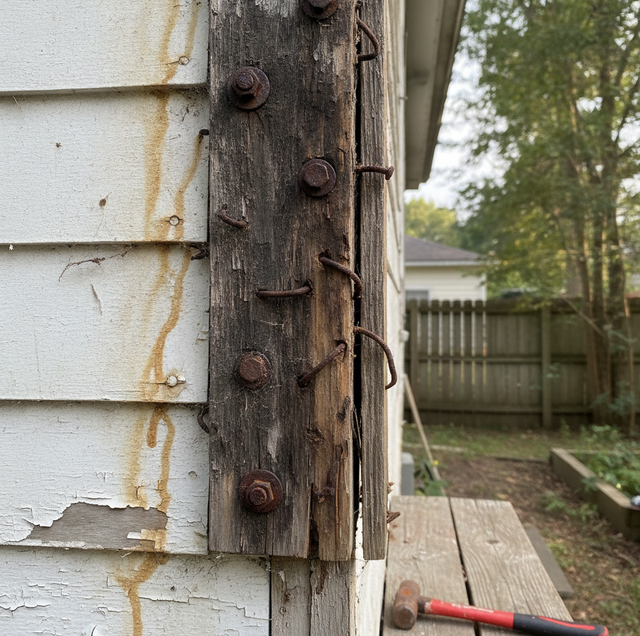
The two things that go wrong here are how it is fastened and what sits behind it. A ledger held on with nails or deck screws instead of through-bolts or lag screws is a serious problem; nails pull straight out under load and were never rated to hold a deck to a house. Look for the heads of large bolts or lag screws spaced along the board. If you see only nail heads or small screws, treat the deck as suspect until a professional confirms otherwise.
The second issue is water. If there is no metal flashing tucked behind the siding and over the top of the ledger, rain runs down the wall and sits in the gap between the board and the house. Over a few seasons, that trapped moisture rots both the ledger and the framing of the house behind it, and the rot hides where you cannot see it. Streaking, stained siding, or soft trim right above the deck is a clue that water has been getting in for a long time.
Probe the Wood for Rot You Cannot See by Looking
Wood rot is deceptive. A joist can look solid and gray on the surface, while the inside has turned to punk. The reliable field test is simple: take a flat-head screwdriver or an awl and press the tip firmly into the wood at the spots that stay wet longest.
Sound wood resists the tip and the point barely sinks in. Rotted wood feels soft or spongy, and the screwdriver pushes in easily or lifts up a splintering sliver instead of breaking a clean chip. Probe the bottom edges of the joists, the ends where they meet the ledger, the base of every post, and the stair stringers. Discoloration, a musty smell, or anything that looks like small mushrooms growing on the wood all point to active decay underneath.
You are checking framing here, not just the deck boards. A single soft floorboard is a trip hazard and worth replacing, but soft joists, posts, or a soft ledger are structural and change how safe the deck is to stand on.
Check the Metal: Hangers, Fasteners, and Corrosion
The joists that hold up your walking surface usually sit in metal joist hangers nailed or screwed to the ledger and the beam. Two failures show up here. First, missing fasteners: if you see a hanger with empty holes, someone left out nails, and the connection is carrying far less than it should. Those holes are meant to be filled with structural connector nails, and the specific short, fat nails matter because they carry the load in shear. Second, corrosion. Rusted hangers, rust-streaked wood, or fasteners that have thinned and flaked are losing strength, and rust often means the wrong metal touched pressure-treated lumber, which is corrosive to ordinary steel.
Give the beams and rim a look, too. Cracked, split, or checked framing that runs through a bolt hole or a hanger is weaker than the same board intact. A tight surface check in dry lumber is cosmetic; a split that opens up around a fastener is not.
Push on the Railings and the Posts
Grab the top rail and give it a firm shove outward, the way someone would if they leaned or fell against it. It should not move. A railing that flexes, wobbles, or has loose or missing balusters is one of the most common and most dangerous defects, because railings exist for the exact moment a person's weight is thrown against them. Loose rail posts often trace back to rotted blocking or too few bolts at the post-to-frame connection.
Then move under the deck and check the support posts and their footings. Each post should sit on a concrete footing or pier, not straight on soil. A post whose base has sunk, tilted, or drifted off its footing means the ground moved or the footing was never deep enough, and that shows up as a deck that feels bouncy, slopes to one side, or has developed gaps at the stairs. In areas with clay soil, the soil swells when it is wet and shrinks when it dries, and repeated freeze-thaw cycling heaves shallow footings a little more each year, so a post that was plumb when the deck was built can lean over time.
Tell Cosmetic Weathering Apart From Real Danger
Not every flaw means the deck is done. Faded color, surface splinters, a few popped nail heads, and light gray graying are cosmetic and normal for wood left out in the sun and rain. UV and moisture wear the top layer without touching the frame.
The line to watch is whether a problem reaches the structure. The peeling finish is cosmetic; the soft, punky wood beneath it is not. A hairline surface crack is cosmetic; a split that runs through a connection is not. A single loose board is a repair; a loose ledger, sunken post, or wobbling railing is a safety issue. When you are unsure which side of that line something falls on, treat it as structural until someone qualified tells you otherwise.
When Repair Is Enough and When It Is Time to Rebuild
Many aging decks are worth saving. If the framing probes solid and only the hardware, flashing, or a few members are the problem, a pro can re-bolt the ledger properly, add flashing, swap corroded hangers for correctly sized ones, and replace individual rotted boards or a post. That restores a sound deck without a full teardown.
Rebuilding makes more sense when the damage is widespread or when the original build was wrong from the start. Rot in the ledger, and the house band behind it, multiple soft posts, footings that were never poured deep enough, or a structure that was nailed together instead of bolted are the kinds of findings that make a rebuild the safer and more lasting answer. A professional inspection is what tells the two apart, and it is also the moment to sort out permits, since decks attached to a house are structures that a locality expects to be built and inspected to current standards, even if the old one predates them.
Putting the Signs Together
No single clue tells the whole story. A wobbly railing on its own might just need new bolts, but a wobbly railing plus a bouncy floor plus rust on the hangers plus a stained wall above the ledger is a deck telling you it is at the end of its safe life. Walk the deck once a year, probe the wood, look under it, and pay closest attention to the ledger and the connections, because those are what keep the whole thing standing. Catching one of these signs early is the difference between a scheduled repair and a collapse.
Frequently Asked Questions
Work it from three vantage points. From outside on the deck, sight along the ledger where it meets the house and look for a row of lag-bolt or through-bolt heads with washers spaced out along the board; if all you find is a line of nail heads, that is the danger sign that the deck was only nailed on. While you are there, check the top of the ledger for cap or Z-flashing tucked up behind the siding above it, which is what keeps water out of the joint. Then go down into the basement or crawlspace on the other side of that wall and look at the back of the rim joist: on a proper installation, you will see the bolt ends poking through with nuts and washers snugged against the framing. Back outside, watch for a gap opening up between the deck and the house wall or the deck edge pulling down lower than the doorway threshold, either of which means the connection is separating and needs a pro now.
Use a flat-head screwdriver, or an awl or ice pick if you do not have one, and push the tip into the wood with steady hand pressure, never a hammer. Concentrate on the ends of boards and the ledger, where water collects and the exposed end grain wicks it deep into the fibers. On sound wood, the tip stops at the surface and barely dents it; on rotted wood, it sinks in under light pressure and pries up a soft, stringy sliver instead of snapping off a crisp chip. Probe every foot or so along each member rather than testing one spot, because rot hides in localized wet pockets and the board a hand-width away can still be solid while the pocket next to it is gone.
Not necessarily, but it always needs fixing before anyone uses the deck, because railings catch people at the exact moment they fall against them. A wobble often comes from loose lag bolts, too few fasteners at the rail posts, or rotted blocking where the post ties into the rim joist, and any of those can be corrected without touching the rest of the structure. The catch is that the same moisture that loosened the railing may have reached the framing it bolts to, so a loose rail is a reason to look harder at the members underneath rather than a signal to stop looking.
A yearly walk-around is the general standard, plus a look after any major storm. Beyond the surface items a homeowner catches, a pro checks the load path: whether the ledger is flashed and bolted correctly and what condition the house band behind it is in, whether joist hangers are the right model with every fastener hole filled, whether footings are deep enough and posts are properly attached to beams, and whether lateral-load connectors are present to keep the deck from pulling away from the house. They are reading how the parts work together, not just whether each piece looks fine on its own.
It depends on where the damage sits. If the framing probes solid and the trouble is hardware, missing flashing, a corroded hanger, or a few rotted boards, targeted repairs will restore it. Rebuilding becomes the honest answer when the rot has reached the ledger and the house framing behind it, when several posts or footings have failed, or when the original deck was fastened and built in a way that was never sound. Age alone is not the deciding factor; a well-built, well-drained deck can last decades, while a poorly flashed one can be structurally gone in under ten years.
The base of a post is a moisture trap. Where a post sits directly on soil or in a low spot that puddles, it wicks up water and stays damp long after rain, and constant contact with wet ground feeds decay fungi even in pressure-treated lumber. That is why posts are supposed to be set on a concrete footing or a raised metal post base that lifts the wood off the dirt and allows it to drain and dry. Poor drainage around the deck, a downspout dumping nearby, or grade that slopes toward the posts all speed up base rot, so fixing the water is part of fixing the post.
Not sure whether your deck is safe to stand on — get it inspected before the next gathering. Eagle Home Renovation Inc. serves Richmond and surrounding areas. License #2705181053. Call (804) 538-3334.
